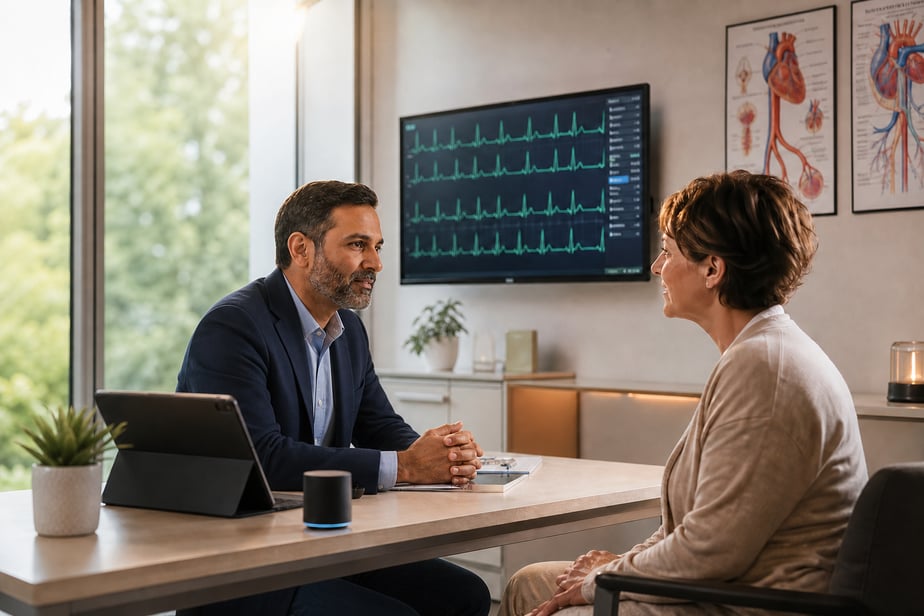
By the time a patient walks into a cardiology clinic, the work has already begun.
Their medical history has been reviewed. Previous clinic letters have been read. ECGs, echocardiograms and blood test results have all been considered before a single question is asked.
Over the next 20 or 30 minutes, the consultation unfolds. Symptoms are explored. Risk factors are discussed. Medications are reviewed. Diagnoses are explained. Treatment options are considered, and follow-up plans agreed.
For the patient, that's the appointment. For the clinician, it's only half the job.
Once the consultation ends, everything that was said, observed and decided needs to become a clear, structured and accurate clinical record. Every note has the potential to inform future decisions, support continuity of care and ultimately improve patient outcomes.
It's an essential part of modern healthcare, but it's also one of the biggest demands on a cardiologist's time.
Why documentation is so demanding in cardiology
Cardiovascular disease remains the world's leading cause of death, accounting for an estimated 17.9 million deaths globally each year. As demand for cardiology services continues to rise, clinicians are balancing increasingly complex patient needs with ever-growing administrative responsibilities.
Consultations often involve multiple layers of information gathered during a single appointment.
A clinician may need to document:
- Detailed patient histories
- Presenting symptoms and timelines
- Cardiovascular risk factors
- Medication reviews
- Results from ECGs, echocardiograms and other diagnostic tests
- Physical examination findings
- Treatment decisions
- Follow-up plans and referrals
Many patients also present with multiple long-term conditions, making consultations longer and documentation even more comprehensive. Producing accurate clinical documentation while maintaining eye contact, listening and building rapport with patients is a constant balancing act.
As a result, clinicians often find themselves dividing their attention between the patient and the screen, making it harder to deliver the natural, uninterrupted conversations that are essential for high-quality care.
When technology becomes part of the conversation - without interrupting it
Ambient speech technology is already helping clinicians across healthcare spend less time documenting and more time focusing on patient care. For cardiology teams, where consultations are often information-heavy and documentation requirements are particularly demanding, the benefits can be even greater.
Instead of asking clinicians to split their attention between the patient and the screen, G2 Speech’s SpeechAmbient works in the background, capturing clinical conversations and transforming them into structured documentation for review.
Clinicians remain in full control of the final record, but without having to start every note from scratch.
It helps preserve the natural flow of the consultation. There’s no need to worry about capturing every detail as it’s discussed - cardiologists can instead focus on listening, asking questions and explaining diagnoses or treatment options. All while knowing the conversation has been documented accurately.
As well as reducing administrative burden for busy clinicians, SpeechAmbient also supports greater consistency in medical documentation. Using configurable AI Profiles, healthcare organisations can tailor documentation to align with their own templates, workflows and clinical standards - helping to ensure notes are structured in a way that works for individual teams.
Why now is the right time for ambient speech technology
Every healthcare organisation is looking for ways to give clinicians more time back. While there's no single solution, ambient speech technology is proving to be one of the most practical ways to reduce the administrative demands that accompany every patient consultation.
At the same time, clinicians are under increasing pressure to do more with less. Growing patient demand, workforce shortages and rising documentation requirements mean that every minute spent behind a keyboard is time that can't be spent with patients.
Rather than changing how cardiologists work, ambient speech technology is designed to complement existing clinical workflows, reducing documentation demands without disrupting the consultation.
Solutions such as SpeechAmbient are designed to support - not replace - clinical judgement. Clinicians remain responsible for reviewing and approving the notes, while AI takes care of the repetitive task of producing a structured first draft.
As ambient speech technology becomes part of everyday clinical practice, its success won't be measured by the AI behind it, but by the difference it makes to clinicians, patients and the quality of care.
Cardiology has always relied on the ability to capture, interpret and communicate complex clinical information. As patient pathways become more sophisticated, the way documentation is created must continue to evolve alongside them.
Ambient speech technology represents a shift towards a more natural approach to clinical documentation - one where the conversation remains central, and technology supports the work happening around it.
As healthcare continues to embrace new technologies, the focus will remain on solutions that make everyday clinical work more sustainable while keeping patient care at the heart of every interaction.
Ready to rethink clinical documentation? Request a demo of SpeechAmbient and discover how ambient speech technology can help reduce administrative burden and support more efficient cardiology workflows.